What Is PMI? How It Works and How to Stop Paying It

PMI stands for private mortgage insurance, and it's a policy that protects your lender, not you, if you stop making payments on a conventional loan. You'll typically owe it when your down payment is under 20% (or your loan-to-value ratio, or LTV, is above 80%), and it usually costs somewhere between 0.46% and 1.5% of your loan amount each year, tacked onto your monthly mortgage bill. The good news: PMI is not permanent. Lenders must drop it automatically once your balance hits a specific threshold of the home's original value, and you can request removal yourself after passing that point.
Here's what to do with that information right now:
- Run your numbers through a mortgage payment calculator to see how PMI changes your monthly total.
- Call your loan servicer and ask exactly when your PMI is scheduled to end, and whether you qualify for early cancellation.
- If you're still shopping for a loan, ask about lender-paid PMI or piggyback structures that might sidestep the cost entirely.
Key Takeaways
| Point | Details |
|---|---|
| PMI protects the lender | It covers lender losses in default; it does not protect your credit or stop foreclosure. |
| Triggered by low equity | Conventional loans with LTV above 80% (down payment under 20%) generally require PMI. |
| Removal is a right, not a favor | Request cancellation at 80% LTV; lenders must auto-terminate at 78% original value. |
| Costs vary by profile | Credit score, down payment size, and loan term all shift your annual PMI rate. |
| Verify your numbers | Metriqahub's mortgage payment calculator shows your exact monthly PMI impact free, with no signup. |
Table of Contents
- What Is PMI and Who Does It Actually Protect?
- When Do Lenders Actually Require PMI?
- How Much Does PMI Cost, and What Drives the Price?
- How Is PMI Actually Paid? Comparing Your Options
- How Do You Get Rid of PMI for Good?
- PMI Types and What Else You Could Choose Instead
- Is PMI Tax-Deductible?
- Worked Example: PMI on a $300,000 Mortgage
- How to Avoid PMI or Shrink What You Pay
- Check Your Exact PMI Cost Before You Sign
- An Editorial Note on Why PMI Confuses So Many Buyers
- Sources
What Is PMI and Who Does It Actually Protect?
PMI exists for one reason: to cover the lender's downside if you default on a conventional mortgage with less than 20% equity. It reimburses the lender for part of their loss in a foreclosure. It does nothing for you. If you fall behind on payments, you still face foreclosure and the credit damage that comes with it. PMI doesn't pause that process or soften the blow to your credit report, according to the Consumer Financial Protection Bureau.
That distinction trips up a lot of first-time buyers who assume that because they're the ones paying the premium, they're the ones covered. They're not. Think of it less like homeowners insurance protecting your house and more like a co-signer fee. You're the one paying, but the safety net catches the bank.
Lenders don't underwrite PMI themselves. They arrange it through private mortgage insurers, which is why the pricing and terms can vary depending on which company backs your loan. Your lender picks the insurer; you pay the bill. That relationship matters because it's why premiums are often negotiable at the margins but not something you shop for the way you'd shop for car insurance.
A few mechanics worth knowing before you sign anything:
- PMI is separate from homeowners insurance; one protects the structure and your possessions, the other protects the lender's stake in the loan.
- Your PMI rate is locked in based on your credit profile and LTV at origination, though it drops over time as you build equity.
- Some lenders let you request a new home appraisal once your equity has grown faster than expected (say, from a hot local market), which can end PMI years early.
Pro Tip: If home values in your area have jumped since you bought, don't wait for your loan servicer to notice. Order your own appraisal and request PMI cancellation as soon as your calculated LTV crosses 80%. Waiting for the automatic 78% termination could cost you a year or more of unnecessary premiums.
When Do Lenders Actually Require PMI?
The trigger is simple: a conventional loan with a down payment under 20%, meaning an LTV above 80%. That's the line. Cross it, and PMI is almost always part of the deal, according to CFPB guidance.
Refinancing doesn't get you out of it either.
Here's how the thresholds typically play out:
| LTV Ratio | What Typically Happens |
|---|---|
| Above 80% | PMI required on most conventional loans |
| At 80% | Borrower can request cancellation (payments must be current) |
| At 78% of original value | Lender must automatically terminate PMI |
| Below 78% | No PMI on the loan |
How Much Does PMI Cost, and What Drives the Price?
Annual PMI rates commonly range from about 0.46% to 1.5% of your original loan amount, split into monthly installments added to your mortgage payment. On a $300,000 loan, that translates to roughly $115 to $375 a month, a wide enough spread that it's worth understanding exactly where you'll land in that range.
Four factors do most of the work in setting your rate:
- Credit score. Higher scores get meaningfully lower PMI rates; a borrower in the 760+ range often pays half what a borrower with 620 score pays for the same loan.
- Down payment size. A 10% down payment costs less in PMI than a 5% down payment, because your LTV starts lower.
- Loan term. Shorter terms sometimes carry slightly lower PMI rates since the insurer's risk window is shorter.
- Insurer and loan type. Different private mortgage insurers price risk differently, and your lender picks which one covers your loan.
The math itself is simple once you have your rate: multiply your loan balance by the annual PMI rate, then divide by 12. Run your own scenario through a loan payment calculator to see how different rates and balances shift that number.
How Is PMI Actually Paid? Comparing Your Options
Most borrowers never think about this because their lender defaults them into monthly PMI without asking. But you usually have more than one option, and the choice affects both your monthly cash flow and how easily you can drop the coverage later.
Monthly borrower-paid PMI is the standard setup: your premium gets folded into your mortgage payment and adjusts (or disappears) as your equity builds. It's the most flexible option because you can cancel it once you hit the LTV thresholds without refinancing anything. Single-premium PMI means paying the entire policy cost upfront at closing, either in cash or rolled into your loan amount. It lowers your monthly payment but ties up cash (or increases your loan balance) right away, and getting a refund if you sell or refinance early isn't guaranteed. Financed premiums spread that upfront cost into your loan itself rather than requiring cash at closing, which helps if you're short on funds at settlement, but it means paying interest on your PMI for the life of that portion of the loan. Lender-paid PMI flips the structure: the lender covers the premium, but bakes the cost into a higher interest rate for the entire loan term. You never see a separate PMI line, but you also can't cancel it the way you can borrower-paid PMI, because it's baked into your rate permanently unless you refinance.| Payment Method | Cost Structure | Cancellable? | Best For |
|---|---|---|---|
| Monthly borrower-paid | Added to monthly payment | Yes, at 80% LTV | Most buyers who want flexibility |
| Single-premium | Paid in full at closing | Rarely refundable | Buyers with cash reserves who want a lower monthly payment |
| Financed | Rolled into loan balance | Difficult without refinancing | Buyers short on closing cash |
| Lender-paid | Built into interest rate | No, without refinancing | Buyers prioritizing lower monthly costs short-term |
How Do You Get Rid of PMI for Good?
PMI removal follows two clear paths, and both are spelled out in CFPB rules. You don't have to ask; it's required by federal law.
The second path puts you in the driver's seat.
Here's the sequence for requesting cancellation on your own terms:
- Confirm your current loan balance and calculate your LTV against your home's original purchase price or appraised value.
- Check that your payment history is current, with no late payments in the past 12 months (some lenders check 24 months).
- Submit a written cancellation request to your loan servicer once you've crossed 80% LTV.
- If your equity grew faster than your amortization schedule (often from rising home values), order a new appraisal to prove current LTV rather than waiting on the original schedule.
- Confirm in writing once PMI is removed and check your next statement to verify the charge is gone.
A few things to line up before you start the process:
- Recent mortgage statements showing your current balance.
- Proof of on-time payments for at least the past year.
- A comparative market analysis or fresh appraisal if you're arguing for early removal based on rising home values.
- Written confirmation request in case your servicer is slow to update your account.
PMI Types and What Else You Could Choose Instead
Not every PMI arrangement looks the same, and not every high-LTV borrower needs PMI at all. Understanding the landscape helps you pick the right structure before you sign anything.
The four PMI variations you'll encounter are the same ones covered in the payment section above: monthly borrower-paid, single-premium, financed, and lender-paid. Beyond those, two federal loan programs offer entirely separate insurance models:
- FHA loans carry mortgage insurance premiums (MIP) regardless of your down payment in most cases, and unlike conventional PMI, MIP often can't be canceled without refinancing out of the FHA program once your down payment was under 10%.
- VA loans, available to eligible veterans and service members, skip monthly mortgage insurance entirely in favor of a one-time upfront funding fee.
It works well for buyers confident they can manage two payments and who plan to pay down the second loan quickly. An FHA loan might make more sense if your credit score isn't strong enough for competitive conventional PMI rates, since FHA underwriting is generally more forgiving on credit history even though its insurance costs run higher long-term.
Is PMI Tax-Deductible?
The tax treatment of PMI has shifted over the years and depends on the tax year and your income level, so treat any blanket answer with caution. PMI deductibility has historically been tied to itemizing deductions and income phase-out limits, and Congress has let the deduction lapse and then reinstated it retroactively more than once in the past decade.
Because the rules move, don't assume last year's treatment applies to this year's return. Check the current tax year's guidance directly or, better, talk to a tax professional who can confirm whether you qualify given your income and filing status.
A few things worth keeping in mind:
- Deductibility, when available, usually requires itemizing rather than taking the standard deduction.
- Income phase-outs have applied in past years, meaning higher earners may not qualify even when the deduction exists.
- This is general information, not tax advice specific to your situation.
Worked Example: PMI on a $300,000 Mortgage
Numbers make this concrete faster than percentages alone.
Using a mid-range PMI rate of 0.8% annually (a reasonable middle point in the 0.46% to 1.5% range for this LTV tier), here's the math:
$270,000 × 0.008 = $2,160 per year, divided by 12 months = $180 per month in PMI.

That's $285,000 × 0.011 = $3,135 per year, or $261 per month, roughly $81 more each month for putting down $15,000 less at closing.
That gap is exactly the kind of trade-off worth running through a calculator before you commit to a down payment size. To check your own numbers, plug these inputs into the mortgage payment calculator:
- Total loan amount
- Interest rate on the mortgage itself
- Down payment amount and percentage
- Estimated annual PMI rate (ask your lender for their specific quote)
- Loan term (15 or 30 years)
Adjusting any one of these shifts your total monthly housing cost, and seeing the numbers side by side often changes how much down payment buyers decide to bring to closing.
How to Avoid PMI or Shrink What You Pay
Not everyone has that kind of cash sitting around, so here are the realistic paths people actually take.
- Save toward 20% before buying, even if it means renting longer or delaying your purchase timeline by a year or two.
- Ask about lender-paid PMI if you want the lowest possible monthly payment and don't mind a permanently higher interest rate.
- Consider a piggyback loan to split your financing and avoid crossing the 80% LTV line on your primary mortgage.
- Improve your credit score before applying, since even a jump from the low 700s to the high 700s can noticeably lower your PMI rate.
- Ask your lender directly about single-premium PMI if you have cash reserves and want a lower monthly payment without a permanently higher rate.
If you're deciding between these, start with the math: compare the monthly PMI cost against the cost of waiting to save a bigger down payment, since rents and home prices rising while you save can sometimes erase the benefit of waiting. For many buyers, paying PMI for two or three years while building equity beats sitting on the sidelines for that same stretch.
Check Your Exact PMI Cost Before You Sign
Every scenario above uses round numbers to make the math easy to follow, but your actual PMI cost depends on your specific loan amount, credit profile, and lender. Metriqahub's mortgage payment calculator lets you plug in your own loan amount, interest rate, down payment, and estimated PMI rate to see your real monthly total in seconds, free, with no signup required. If you're weighing a piggyback structure or comparing loan sizes, the broader finance calculator hub covers loan payments and percentage comparisons too, so you can model the full range of options before you talk to a lender. Start with your numbers, not a rough estimate; open the calculator and see exactly what your down payment size means for your monthly payment.
An Editorial Note on Why PMI Confuses So Many Buyers
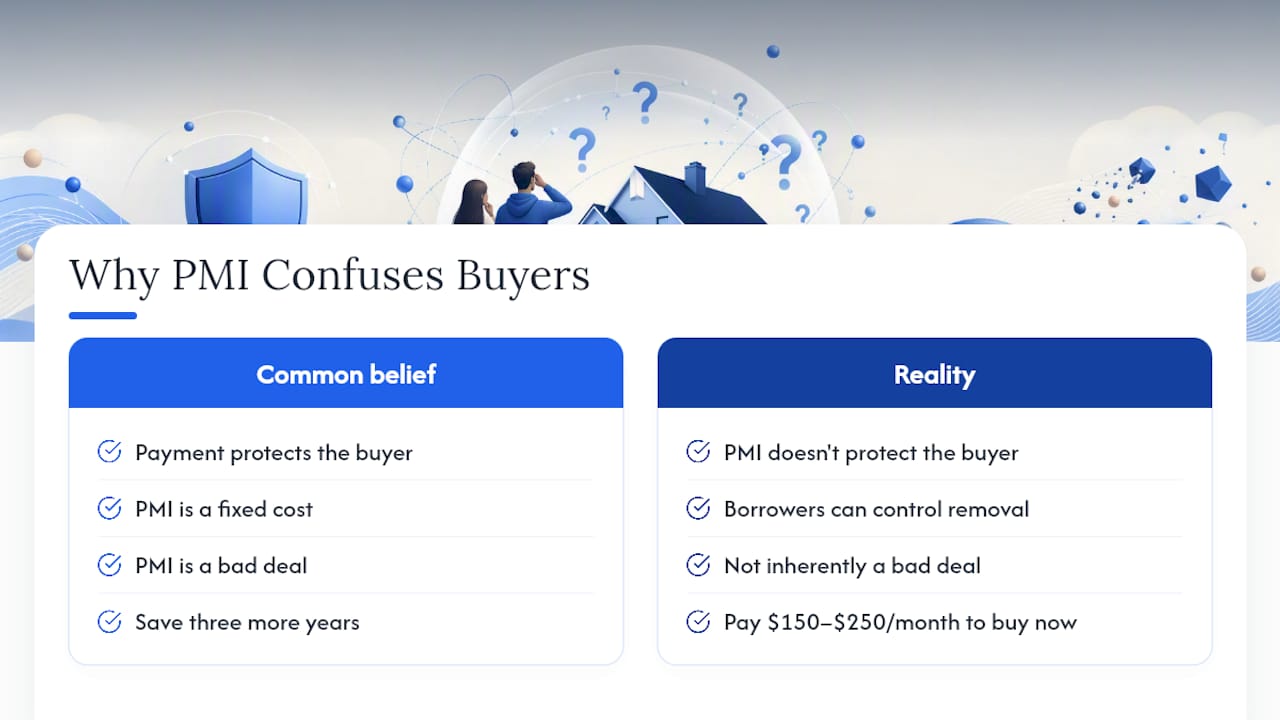
The biggest misconception about PMI isn't the cost. It's the belief that paying for something means you're the one protected by it. That assumption is understandable, since almost every other kind of insurance you buy works that way, but PMI is the exception, and lenders rarely go out of their way to correct the misunderstanding at closing.
What gets underestimated even more is how much control borrowers actually have over removal. Most people treat PMI as a fixed cost they'll pay until their loan servicer decides to drop it. That's backwards.
The other underappreciated point: PMI isn't inherently a bad deal, even though it gets talked about like one. For a buyer with strong income and a stable job, paying $150 to $250 a month to buy now rather than saving for three more years while rents and home prices climb can be the financially smarter move. Metriqahub's calculators exist precisely so that comparison isn't a guess. Run both scenarios, PMI now versus waiting, and let the actual numbers decide instead of a rule of thumb about avoiding PMI at all costs.
This article is general information, not a substitute for advice from a qualified financial advisor. Consult a qualified financial professional about your own circumstances before acting on anything here.
Sources
For readers who want to verify anything above directly at the source, these are the government and industry pages worth bookmarking:
- What is private mortgage insurance? | Consumer Financial Protection Bureau
- Private mortgage insurance (PMI) - Bankrate
- What Is Private Mortgage Insurance (PMI)? - Experian